Time as a Physical Maze
From the 16mm black-and-white leaps of Following (1998) to the bidirectional turnstiles of Tenet (2020), Nolan treats chronology not as playback speed, but as geometry.
READ FULL ESSAY →An independent film-theory archive and interactive mystery exploring memory, non-linear time, simulated reality, Christopher Nolan’s complete chronological filmography from Following (1998) to The Odyssey (2026), and open community discussion.
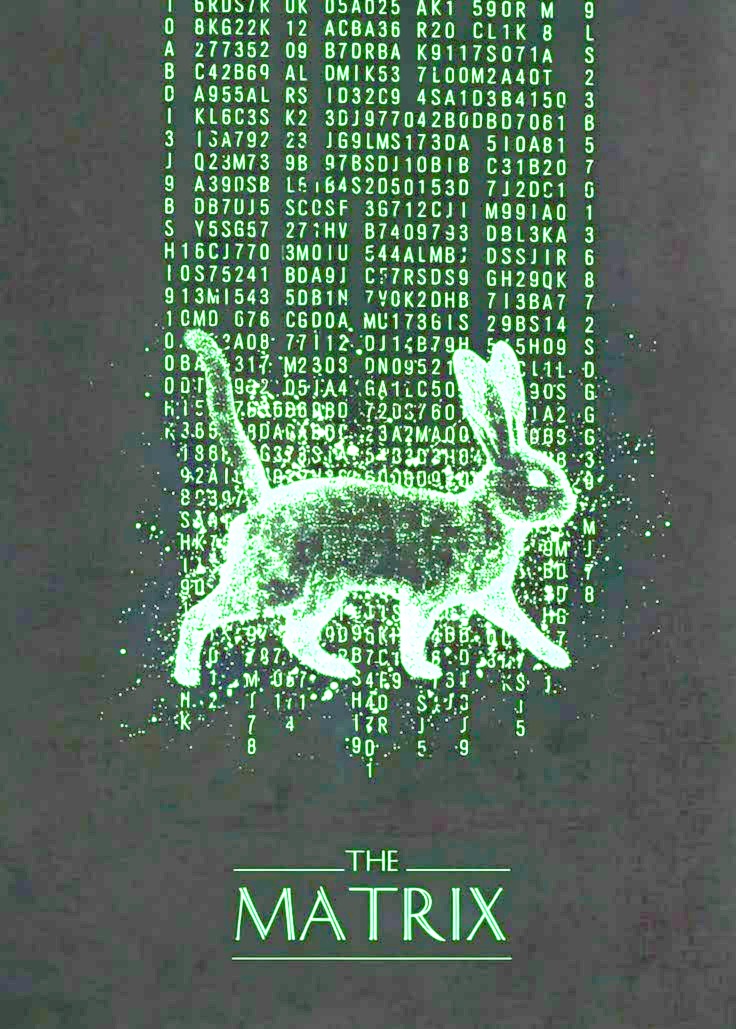
In 1999, The Matrix transformed science fiction by framing reality as an algorithmic cage—an architecture you only perceive once you see the green code behind the drywall. One year later, Christopher Nolan released Memento, starring Carrie-Anne Moss and Joe Pantoliano straight out of the Nebuchadnezzar crew, asking the same epistemological question without a single computer simulation: if memory itself is compromised, how can you verify what is real?
This publication is an independent cinematic thought experiment and filmography guide. Nothing here is presented as an official studio leak or production announcement from any filmmaker or rights holder. Instead, we examine how Nolan’s recurring obsessions—non-linear time, constructed architecture, tactile 70mm IMAX realism, and unreliable perception—intersect with the mythology of The Matrix.
Where the Wachowskis explored digital simulation through cyberpunk philosophy, Hong Kong wire-fu, and late-90s code aesthetics, Christopher Nolan builds metaphysical puzzles out of analog film stock, physical rotation rigs, and interlocking clocks. Below is how the two visual languages compare across six core dimensions.
| DIMENSION | THE MATRIX (1999) | CHRISTOPHER NOLAN APPROACH | SYNTHESIS: THE NEXT LAYER |
|---|---|---|---|
| Nature of Reality | External neural simulation operated by machines to harvest human bio-energy. | Internal or structural illusion: unreliable memory (Memento), nested dreams (Inception), stage magic (The Prestige). | A simulation you do not jack into with cables—one sustained by perceptual consensus and temporal manipulation. |
| Time Mechanics | Bullet Time freezes spatial frames around a moving camera at 12,000 fps virtual interpolation. | Cross-cut time dilation (Inception, Interstellar), braided clocks (Dunkirk), and entropy inversion (Tenet). | Instead of slowing bullets digitally, combat unfolds across forward and inverted timelines simultaneously in-camera. |
| Visual Format | Green-tinted Super 35mm inside the Matrix; cold steel-blue in the real world. | 65mm & 15/70mm IMAX celluloid, practical miniatures, and full-scale physical sets (culminating in The Odyssey). | Shot on large-format film where the "Construct" looks tactile, architectural, and physically unsettling. |
| The Architect | An algorithmic program balancing equations and systemic anomalies across six iterations. | Engineers, magicians, dream architects (Ariadne, Cobb), and builders crossing moral thresholds (Oppenheimer). | The Architect is not a distant hologram—it is the protagonist’s own blueprint waiting to be uncovered. |
| Sound Design | Don Davis’s brass clusters fused with industrial breakbeats and Rob Dougan electronics. | Shepard-tone acoustic escalation, ticking pocket watches, and sub-bass IMAX organs (Zimmer & Göransson). | A relentlessly ticking rhythmic pulse where silence signals a fracture between layers. |
| Philosophical Core | Determinism vs. Choice ("Because I choose to"). Awakening from comfortable sleep. | "What’s happened, happened" vs. moral accountability and the cost of truth over comfort. | Knowing the trick is an illusion does not free you—acting inside the illusion changes what it means. |
From the 16mm black-and-white leaps of Following (1998) to the bidirectional turnstiles of Tenet (2020), Nolan treats chronology not as playback speed, but as geometry.
READ FULL ESSAY →Why Inception (2010) shares DNA with The Matrix: totems vs. red pills, Ariadne’s folded Paris vs. the Construct, and Mal as a warning against comforting illusions.
READ FULL ESSAY →How shooting on practical locations and full-frame IMAX film—culminating in 2026’s The Odyssey—creates weight that CGI alone struggles to replicate.
READ FULL ESSAY →Every feature film directed by Christopher Nolan from his micro-budget 1998 debut Following through his landmark 2026 epic The Odyssey—arranged in strict release order with runtimes, production data, temporal mechanics, and direct conceptual links to The Matrix. Click any year in the index bar to jump directly to a film, filter by theme, or click Ask / Comment on any card to join the discussion.
Have a question about Nolan’s timeline structure, a specific film from 1998 to 2026, a parallel to The Matrix, or a clue inside the five puzzle levels? Post a question or comment below, filter open questions, upvote insightful theories, and reply directly to other visitors.
The transmission does not arrive in language. It arrives in rhythm. Watch it long enough and the noise begins to mean something.
Each leap felt unimaginable, until it was normal. The pattern does not stop — it only quiets down between movements, the way a long film does before its final act.
The first writing systems appear in Mesopotamia — thought becomes storable, transferable, and suddenly mortal in a new way.
Gutenberg's movable type turns knowledge into something reproducible. The same sentence can live in a thousand rooms at once.
Watt's steam engine ignites the industrial age. Time, for the first time, becomes something that can be measured in horsepower.
The first public power grid switches on in New York — the world stops sleeping in the dark, and the night becomes a shift.
ENIAC becomes one of the first general-purpose electronic computers. Logic leaves the human skull and finds a chassis.
The term "Artificial Intelligence" is coined at Dartmouth. A new noun enters the language — and immediately begins to drift.
ARPANET sends its first message between two machines. The message was meant to be "LOGIN". It arrived as "LO". A prophecy in two letters.
Deep learning triggers a new wave of machine intelligence. The machines begin to recognize cats, faces, cancer, and, eventually, intent.
No confirmation. No denial. Only a question, and the suspicion that the answer is already moving through the wires.
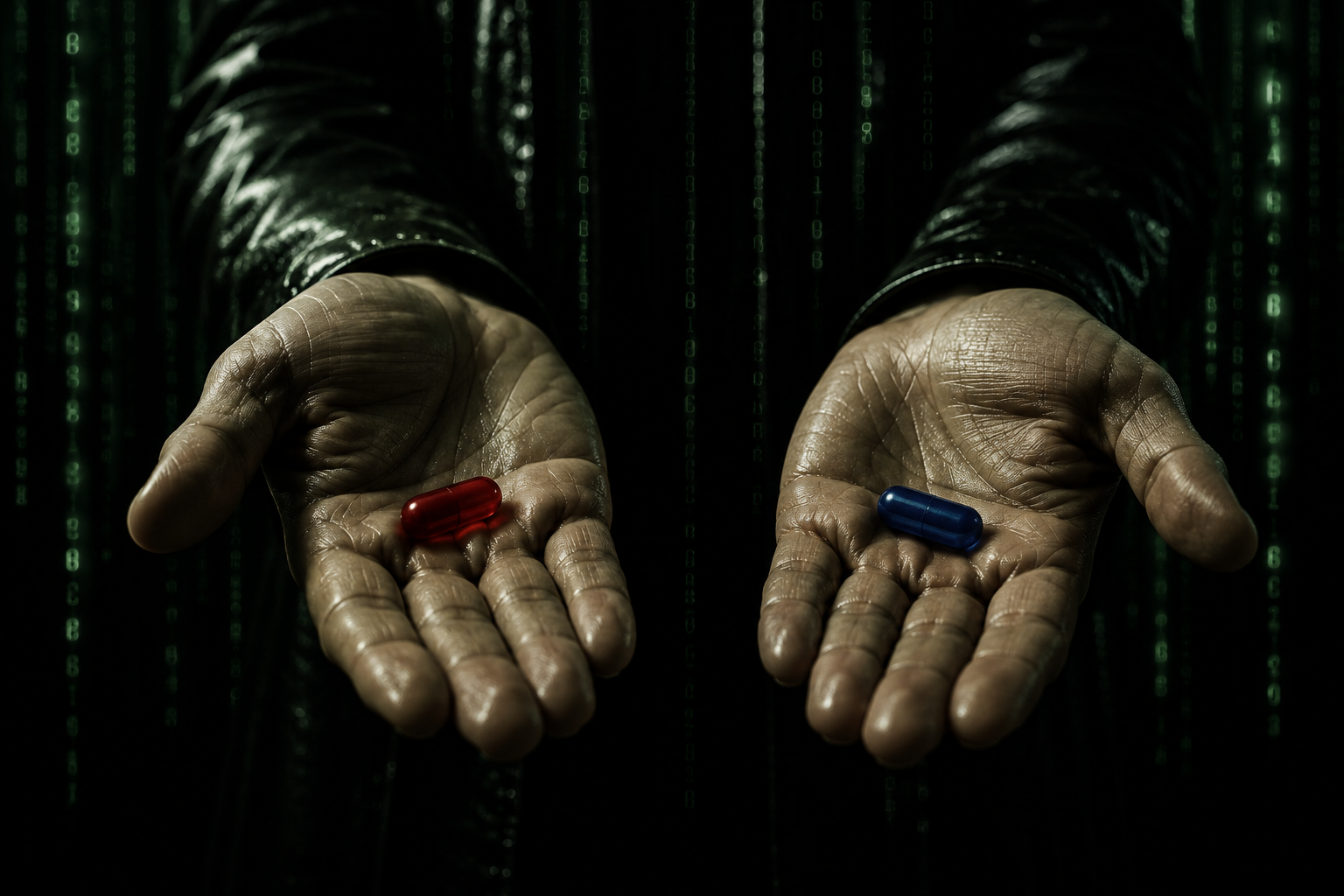
The pills do not choose what is real. They choose what you are willing to remember. One opens a door. The other locks it from the inside.
Remember the sequence. Then reconstruct it. The layer only opens to those who can hold a pattern under pressure.
A frame was recovered from the archive. One detail does not belong. Scan the image. The signal hides where the eye refuses to look.
Three whispers have arrived. Each separated by exactly three years. The fourth is already on its way. Enter the year it will arrive.
Every previous layer has named you. Every signal has addressed you. The word has been spoken since the first scroll. Type the word that the page has been calling you.
If this question interests you, send the signal to someone else. Discuss a film or leave a question in the community board above.